
Temporal Bone Malignancy
Temporal Bone Malignancy Services
At Spokane ENT, we provide comprehensive diagnosis and treatment of temporal bone malignancies, rare cancers that affect the ear and skull base region. These tumors can arise from various structures within the temporal bone including the external ear canal, middle ear, mastoid, or petrous apex, and may include squamous cell carcinoma, adenocarcinoma, adenoid cystic carcinoma, and other rare histologic types. Our team performs thorough evaluation including detailed history taking, physical examination, and advanced imaging studies including computed tomography (CT) and magnetic resonance imaging (MRI) to accurately stage these complex malignancies and develop individualized treatment plans.
We utilize a multidisciplinary approach to temporal bone malignancy management, working closely with head and neck surgeons, neurosurgeons, radiation oncologists, and medical oncologists to ensure comprehensive care. Our evaluation includes assessment of tumor extent, involvement of critical structures such as the facial nerve, carotid artery, and brain, and evaluation for regional and distant metastases. We perform comprehensive staging to help guide treatment decisions and predict outcomes. Our team also coordinates with pathologists to ensure accurate histologic diagnosis, which is critical for determining the most appropriate treatment strategy.
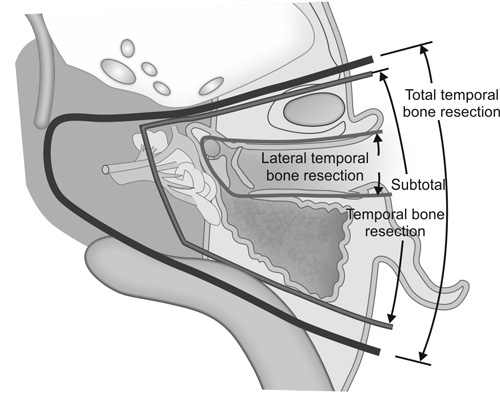
Our treatment approach for temporal bone malignancies typically involves surgical resection as the primary modality, often combined with postoperative radiation therapy. Surgical procedures may include lateral temporal bone resection (LTBR), subtotal temporal bone resection, or total temporal bone resection depending on tumor extent and location. These complex procedures require careful planning and execution to achieve oncologic control while preserving critical neurovascular structures when possible. Our surgeons have extensive experience with these challenging procedures and work closely with a multidisciplinary team to ensure optimal outcomes. Postoperative care includes close monitoring, rehabilitation, and coordination with radiation oncology and medical oncology teams for adjuvant therapy when indicated.
Temporal Bone Malignancy Resources
Frequently Asked Questions
Temporal bone malignancies are rare cancers of the ear and surrounding skull bone. They may arise from skin cancer (e.g., squamous cell) or from the ear structures. Early detection is important.
Symptoms may include persistent ear drainage, ear pain, hearing loss, facial weakness, or a mass in or around the ear. See an ENT for evaluation of concerning symptoms.
Treatment typically involves surgery, often combined with radiation. Extent of surgery depends on the stage. Your care team will create an individualized treatment plan.
Otologists and head and neck surgeons with expertise in skull base surgery typically lead care. Spokane ENT works with specialists for these complex cases.
See an ENT if you have a non-healing sore in or around the ear, persistent ear drainage or pain, or facial weakness. Early evaluation improves treatment options.